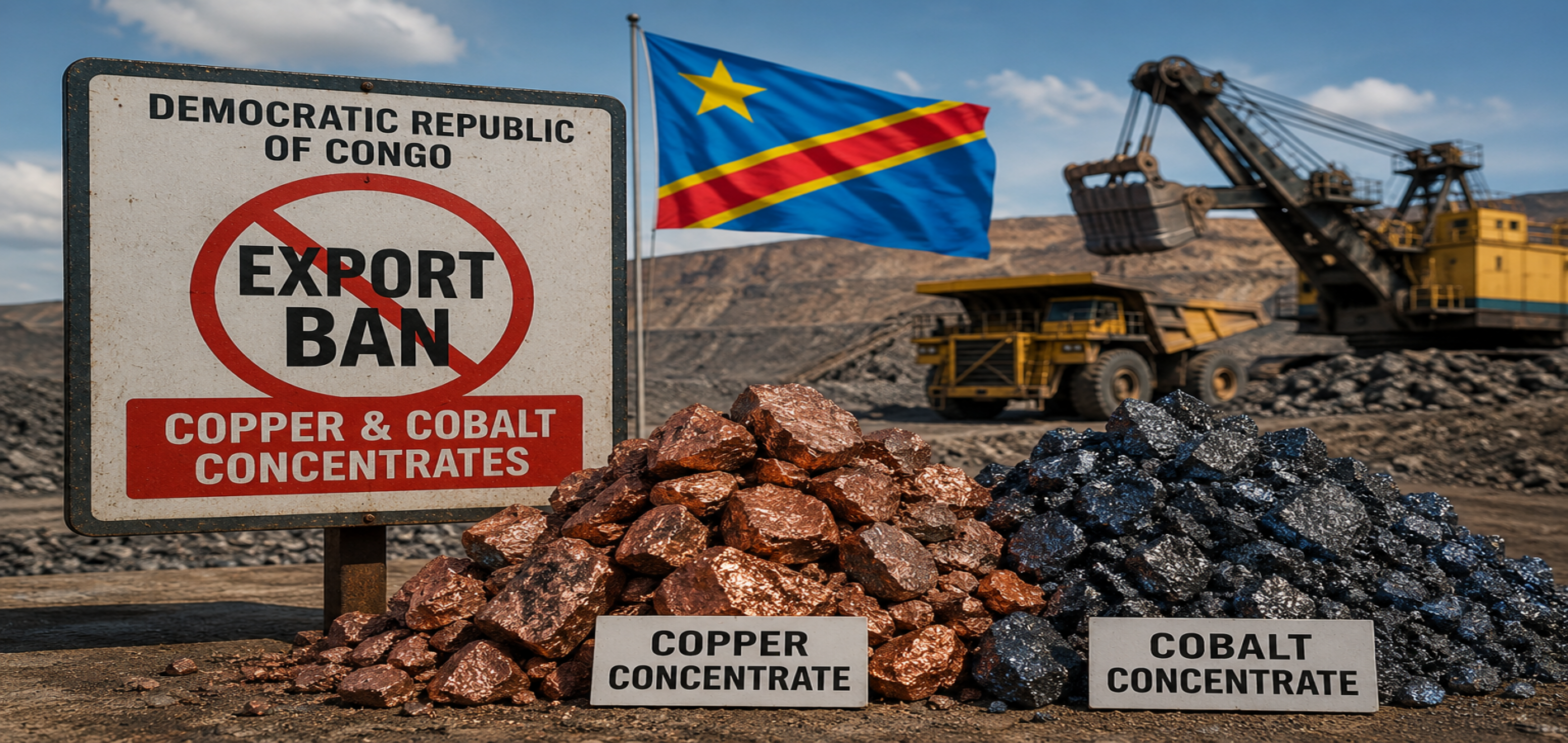
The Congo copper and cobalt export ban has officially taken effect after the Democratic Republic of Congo prohibited exports of copper and cobalt concentrates. The government hopes the move will encourage local mineral processing, increase industrial investment, and retain more value from the country’s vast mining resources.
_x000D_The new regulation immediately impacted global commodity markets. As a result, international copper prices climbed sharply following the announcement.
_x000D_ _x000D_Congo Introduces Immediate Export Ban
_x000D_The Democratic Republic of Congo issued a government order banning exports of copper concentrate and cobalt concentrate. The directive was signed by Mines Minister Louis Kabamba Watum, Foreign Trade Minister Julien Paluku Kahongya, and Economy Minister Daniel Mukoko Samba.
_x000D_Furthermore, the order became effective immediately. However, authorities may grant one-year export waivers under special strategic circumstances.
_x000D_Government officials said the policy aims to ensure mining companies process more minerals inside the country instead of shipping raw concentrates overseas.
_x000D_ _x000D_Copper Prices Jump After Announcement
_x000D_Global markets reacted quickly to the Congo copper and cobalt export ban.
_x000D_Copper futures on the London Metal Exchange surged by as much as 1.8%, reaching $14,369.50 per metric ton, the highest level since January. Although prices later eased slightly, they remained well above previous trading levels.
_x000D_Investors expect the export restrictions to tighten concentrate supplies while increasing demand for refined metals.
_x000D_ _x000D_Congo Wants More Domestic Processing
_x000D_The Democratic Republic of Congo remains the world’s largest producer of cobalt and one of the leading suppliers of copper.
_x000D_Therefore, officials believe exporting raw concentrates limits the country’s economic benefits.
_x000D_Instead, the government wants mining companies to refine minerals domestically before exporting finished products. Consequently, officials hope to create jobs, attract industrial investment, and strengthen the national economy.
_x000D_The government stated that exporting higher-value mineral products will help maximize revenue generated from Congo’s natural resources.
_x000D_ _x000D_Similar Export Restrictions Have Happened Before
_x000D_This is not the first time Congo has imposed restrictions on mineral concentrate exports.
_x000D_Authorities introduced similar bans in 2013, 2019, and 2023. Nevertheless, temporary exemptions were granted because local smelting capacity was still developing.
_x000D_The latest order replaces the 2023 regulation while introducing broader rules governing mineral exports and taxation.
_x000D_ _x000D_Mining Companies May Face Challenges
_x000D_Although Congo already exports most copper as refined metal, several mining operations still rely on concentrate exports.
_x000D_According to official data, Congo exported nearly 697,000 tons of copper cathodes during the first quarter of 2026. Meanwhile, it shipped around 54,000 tons of copper concentrates containing approximately 18,863 tons of copper metal.
_x000D_Additionally, the country exported almost 52,000 tons of cobalt hydroxides during the same period.
_x000D_Mining analysts believe companies that still depend on concentrate exports could experience operational adjustments while expanding local processing facilities.
_x000D_ _x000D_New Mining Tax Rules Introduced
_x000D_Besides export restrictions, the government also announced a revised taxation system covering economically significant mining by-products.
_x000D_The new framework applies taxes to trace and ultra-trace minerals recovered during refining operations. Moreover, the regulation establishes a three-month transition period before the new tax system is fully enforced.
_x000D_Officials say the updated policy supports Congo’s broader strategy of increasing value-added production within its mining industry.
_x000D_ _x000D_Global Mining Industry Watches Closely
_x000D_The Congo copper and cobalt export ban is expected to influence global mineral supply chains over the coming months.
_x000D_Because Congo plays such a critical role in supplying battery metals for electric vehicles and renewable energy technologies, international manufacturers and commodity traders will closely monitor how mining companies respond.
_x000D_If domestic refining capacity expands successfully, Congo could strengthen its position not only as a major producer of raw minerals but also as a significant exporter of processed metals.